
Families often notice an immediate spark when a child explores a keyboard—the clear patterns, repeatable sounds, and tactile feedback can feel welcoming and predictable. For many autistic learners, that combination makes the piano an ideal entry point into music making and a powerful tool for communication, regulation, and self-expression. With thoughtful structure, a strengths-based approach, and flexible goals, piano lessons for autism can become a long-term source of pride, routine, and joy. The key is not forcing a single method, but designing an accessible path that honors sensory needs, processing differences, and personal interests while systematically building technical fluency and musical understanding.
What Makes Piano Lessons Work for Autistic Learners
Piano is inherently visual, tactile, and auditory—qualities that can synchronize beautifully with the learning profiles of many autistic students. The keyboard’s linear layout reduces ambiguity: low to high is left to right, sharps and flats follow consistent patterns, and finger numbers map logically to specific keys. This concrete design supports pattern recognition, which is often a strength. When lesson plans use predictable routines—such as a warm-up, technique focus, core repertoire, free-choice activity, and a brief review—students know what to expect and can engage without the stress of uncertainty.
Effective piano lessons for autistic child learners acknowledge sensory processing. Weighted keys, adjustable benches, footrests, and soft lighting minimize overstimulation. Noise-reduction strategies—like using headphones, controlling volume, and limiting competing sounds—help students focus on the task at hand. Visual supports (color-coding for finger numbers or scale degrees), simplified notation, and large-print scores reduce cognitive load. Many students benefit from multi-sensory teaching: clapping rhythms, stepping beats, tapping finger patterns on the fallboard, then transferring that pattern to the keys. This sequencing strengthens memory and motor planning.
Communication supports are also vital. Short, direct instructions paired with modeling and visual prompts increase clarity. First-then boards, visual timers, and token systems create transparency around transitions and rewards. Crucially, the tone remains collaborative and autonomy-supportive; offering choices (which piece first, which hand to warm up, which rhythm game) increases motivation and buy-in. Interest-based learning—arranging a favorite theme, composing a short motif about a special interest—builds powerful intrinsic motivation and can unlock fluent practice at home.
Over time, these elements converge into lasting musical skills. Technique can be taught through pattern-based exercises (five-finger positions, chord shells, ostinatos) that avoid overwhelming notation early on. Musicality grows through call-and-response phrasing, guided improvisation, and play-along tracks. Executive function is supported by bite-sized goals, clear checklists, and consistent review. The result is a lesson experience that feels safe, purposeful, and genuinely enjoyable—one that nurtures both competence and confidence.
Teaching Strategies a Skilled Piano Teacher for Autism Uses
Instruction succeeds when it is individualized, flexible, and affirming. A seasoned teacher starts with an intake that explores sensory preferences, communication style, regulation strategies, and musical interests. From there, goals are set using clear, observable criteria: “Play a C major five-finger exercise at 60 bpm with steady pulse, using relaxed wrist alignment, three times in a row.” Specificity matters because it guides daily practice and makes progress measurable.
Finding a piano teacher for autistic child who blends musicianship with a neurodiversity-affirming approach can be transformational. Such a teacher views behavior as communication, builds co-regulation into lessons (breathing prompts, body scans, movement breaks), and uses scaffolding to prevent overwhelm. Errorless learning—breaking tasks into small, successful steps—can be paired with shaping and chaining techniques: mastering the final measure first (backward chaining), then adding preceding measures until the whole piece flows. Rote teaching isn’t a shortcut; it can be a powerful way to frontload musical patterns while notation skills catch up at a comfortable pace.
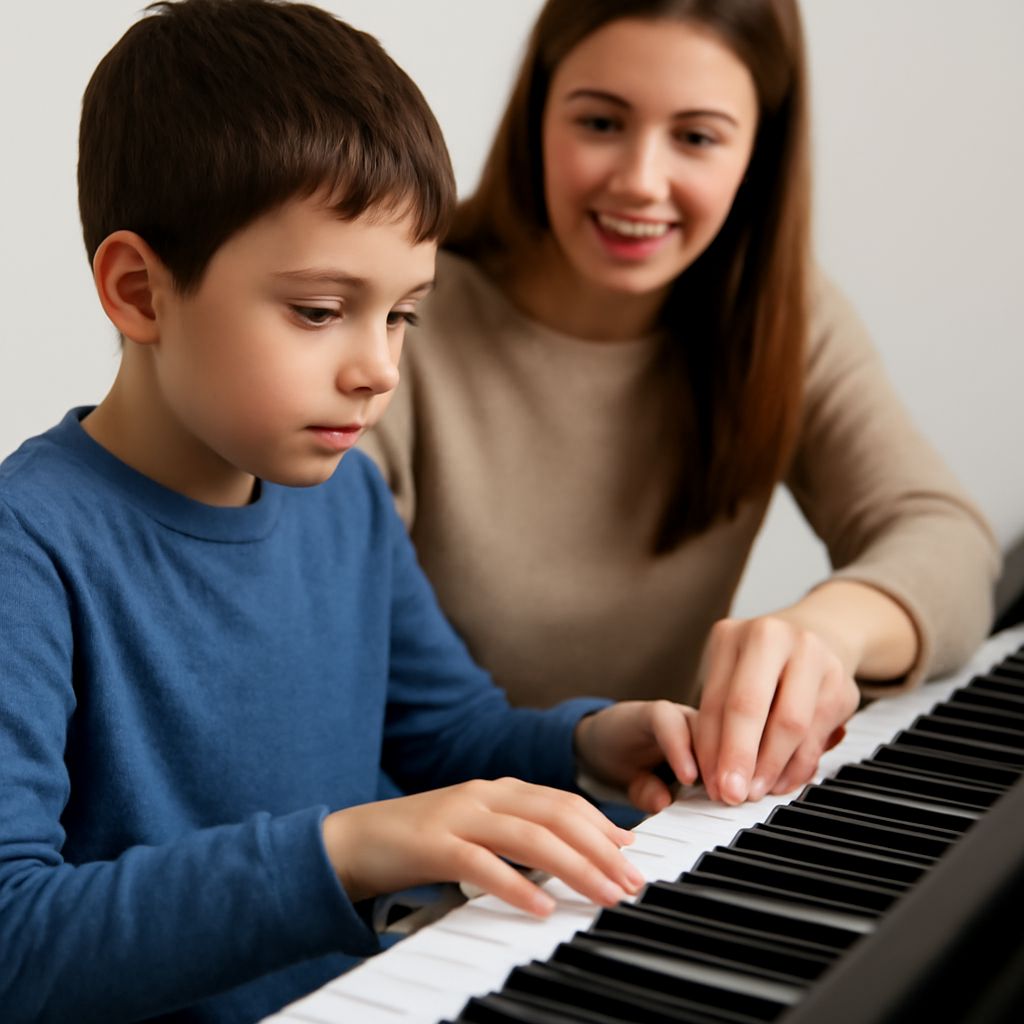
Adaptive materials and technology expand access. Large-print or dyslexia-friendly fonts, colored noteheads aligned with finger numbers, and simplified lead sheets can make reading more approachable. Digital tools—slow-down apps, loopers for tricky passages, and on-screen metronomes with visual cues—support steady practice. For some learners, alternate notation that emphasizes intervals, patterns, or chord symbols provides an “aha” bridge to standard notation later.
Practice plans thrive on structure and choice. A five-minute “win” routine (one exercise the student can already play well) builds momentum. Then, two to three micro-goals—one technical, one musical, one creative—keep variety without diluting focus. Choice time at the end sustains joy: brief improvisations on a pentatonic scale, creating a left-hand drone, or layering a simple rhythm with a backing track. Parents can support by maintaining a calm environment, celebrating small wins, and using visual trackers rather than verbal reminders. Consistent routines matter more than marathon sessions; five to ten focused minutes, five days a week, often outperforms a single long weekend practice.
For recital readiness, flexible performance formats are empowering. In-studio “micro-recitals,” audio or video recordings shared privately, or small sensory-considerate showcases with clear expectations can replace traditional high-stimulation events. Social stories, rehearsal in the performance space, and noise-management plans set students up for success. When the arc of preparation is compassionate and predictable, students commonly exceed their own expectations.
Real-World Examples and Progress Tracking
Case Example 1: A nine-year-old who loves trains struggled with notation but adored patterns. Lessons began with keyboard mapping games using “stations” (keys) and “tracks” (intervals). The teacher introduced a theme-and-variation piece titled “Express to C Major,” centered on a five-finger position. Rote learning established fluency; then, the student labeled the pattern using finger numbers and finally note names. By week eight, the student could read a short eight-measure piece with accurate rhythm. The interest-led entry point didn’t just motivate practice; it created a durable memory scaffold for reading.
Case Example 2: A teen with strong perfect pitch found finger independence challenging due to fine-motor fatigue. The teacher adapted technique with short, frequent rests, wrist-circumduction warm-ups, and a rotation-based touch to reduce tension. Chord shells and Alberti bass patterns replaced blocked chords to distribute effort. Creative goals—arranging a game soundtrack and recording it—provided meaningful milestones. Over a semester, the student increased tempo tolerance by 20 bpm and achieved smooth hand coordination on a two-page arrangement without sacrificing comfort.
Case Example 3: An elementary student using AAC required concise directions and visual supports. Lessons used a color-coded system (consistent with the student’s communication device) and a first-then board: “First two measures of right hand, then choose a rhythm game.” Data collection tracked two metrics: independent task initiation and accuracy of note-to-key matching. Through backward chaining and immediate visual feedback, independent initiations rose from 30% to 80% in six weeks, and accuracy improved from 60% to 90%—a clear demonstration that accessible design can accelerate both confidence and skill.
Progress tracking should be transparent and affirming. Short video clips capture technique changes better than checklists alone; side-by-side comparisons every few weeks highlight growth that might otherwise be missed. A simple dashboard—tempo achieved, measures mastered without prompts, comfort ratings before and after pieces, and a record of creative outputs—keeps momentum visible. Goals can shift seasonally: in the fall, focus on reading fluency and two-hand coordination; in winter, emphasize ensemble play-alongs and rhythm; in spring, prioritize composition or recording projects. When celebrated, these arcs reinforce a growth identity around music.
Importantly, goals should include self-regulation and enjoyment, not just technical markers. A student who independently requests a short break and returns to the bench with renewed focus has achieved a meaningful outcome. A family who notices calmer evenings after short, structured practice has gained a quality-of-life benefit. These wins matter as much as a new scale or a faster tempo. By weaving measurable skill-building with personal agency and sensory trust, piano teacher for autism specialists help students build musical skills that endure—on and off the bench.

A Sarajevo native now calling Copenhagen home, Luka has photographed civil-engineering megaprojects, reviewed indie horror games, and investigated Balkan folk medicine. Holder of a double master’s in Urban Planning and Linguistics, he collects subway tickets and speaks five Slavic languages—plus Danish for pastry ordering.